
- 4E, No.3 Shenfeng Road, Liuyao Community, Henggang Street, Longgang District, Shenzhen,China
- cc.shen@xypltd.com
- Call: +86 15112667855
News
Design basic components for single pair Ethernet applications
- 2026-10-13
As manufacturers and solution providers seek to connect more and more machines and sensors to the Internet to achieve higher automation, real-time monitoring and data collection, the global industrial Internet of Things (IIoT) market is expected to grow at a double-digit annual growth rate, and the market size is expected to reach US $59.6 billion by 2029. Single Pair Ethernet (SPE) technology brings new opportunities for product designers to explore the needs of applications such as sensors, actuators, cameras, displays, controllers, gateways, and switches.
The working group responsible for developing the IEEE 802.3gg standard for 10 Mb/s SPE is primarily dedicated to addressing the "Ethernet gap" issue at the edge of industrial networks. Due to its advantages such as being more economical, easier to install, less sensitive to noise, and easier to transmit power over networks, non Ethernet fieldbuses dominate in automation network connections.
Unlike traditional Ethernet that uses four pairs of twisted pair cables, SPE uses a single pair of twisted pair cables to transmit data at a speed of 10 Mbps in industrial applications using 10Base-T1L, with a transmission distance of up to 1000 meters. SPE can be combined with Single Pair Power over Ethernet (SPoE) technology to simultaneously power IIoT devices and transmit data between IIoT devices.
SPE and SPoE bring the advantages of a universal physical layer (PHY) and standardized network interface cards (NIC) to industrial automation, and provide greater flexibility for equipment suppliers to interact and communicate through Ethernet. The longer distance data and power transmission capabilities make communication between devices easier, while also reducing the need for sensors and other devices to use batteries.
SPE brings various advantages to solution designers and customers, including reduced wiring weight and costs, compatibility with existing Ethernet infrastructure, and greater flexibility in expanding industry standard technologies. The challenges faced in designing SPE applications include overcoming electromagnetic interference, signal integrity, power transmission, and thermal management issues.
Components required for SPE applications
Designing 10Base-T1L SPE applications requires multiple components, including common mode choke (CMC), differential mode inductor (DMI), and isolated coupling inductor, to ensure power and data integrity, isolation, and noise filtering. TDK is the first supplier to provide all the inductors required for industrial SPE, enabling charged or uncharged transmission.
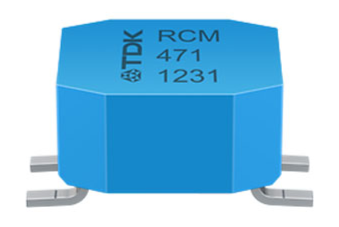
If the plan is to only use 10Base-T1L for data transmission between control and sensing or action components, designers only need to use CMC that can filter out noise. TDK's RCM70CGI-471 (Figure 1) can suppress asymmetric interference coupled on the line without affecting the data signal. Its operating temperature range is -40 to+125 ° C, with a rated voltage of 80 VDC.
Figure 1: RCM70CGI common mode choke used by TDK for interference suppression. (Image source: TDK)
For PoDL applications, designers also need to use differential mode inductors, such as TDK's PID75-650M (Figure 2), to reduce impedance and ensure power transmission integrity. Its rated inductance value is 2 x 65 μ H, with low DC resistance and a working temperature of up to+150 ° C.
Figure 2: TDK's PID75-650M differential mode inductor can reduce impedance and ensure power transmission integrity. (Image source: TKD)
In situations where safety requirements are high and electrical isolation is necessary, designers need to use isolated coupled inductors to supplement CMC and DMI to prevent unwanted currents between devices. TDK's ICI70CGI-222 (Figure 3) has a rated inductance of 2.2 mH, stray capacitance of less than 20 pF, and a voltage intensity of up to 2250 VDC.