
- 4E, No.3 Shenfeng Road, Liuyao Community, Henggang Street, Longgang District, Shenzhen,China
- cc.shen@xypltd.com
- Call: +86 15112667855
News
Current detection amplifier suitable for space constrained applications
- 2026-10-20
No one wants electronic products that are bulky and inefficient. Manufacturers hope that designers can install higher performance components in a smaller space without affecting functionality. In other words, the task is to find ways to overcome challenges and achieve higher accuracy with a smaller electronic application space. Among them, current detection amplifiers are crucial for efficient power management, safe equipment operation, and noise sensitive motor control.
Current detection amplifiers are widely used in applications such as battery management, overcurrent protection, and fault detection. They play an important role in circuit protection by measuring and amplifying the voltage drop across shunt resistors.
Current detection amplifiers have the characteristics of small size and low cost, making them relatively easy to implement. However, there are also some challenges, such as bandwidth limitations, minimizing electrical noise and interference, and high common mode voltage response. Therefore, choosing a suitable current detection amplifier is crucial for the success of the application.
To determine if the selection is appropriate, the key application features need to be identified first:
The current range and maximum input voltage that the equipment can withstand
Environmental conditions and reliable performance that matches the required temperature range
The amplifier specifications comply with design limitations, including package size, bandwidth, static current, and accuracy
Choose whether to use high voltage side or low voltage side current detection technology based on requirements for accuracy, isolation, and ease of implementation
Analog Devices, Inc. (ADI) offers a set of current sensing amplifiers designed for a wide range of applications in performing bidirectional current measurements in various industrial and automotive applications (certified by AEC-Q100).
AD8410A and AD8411A can be used for both AC and DC measurements, with a wide operating temperature range, small gain error, and a wide operating voltage range, which can meet different system requirements. Both use an in package fine-tuning core that can provide a typical offset drift of ± 0.26 µ V/° C across the entire operating temperature range and common mode voltage range, without the need for chopper and auto zero clocks, which can lead to increased noise and other negative effects.
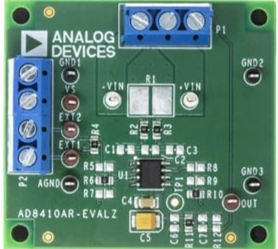
The initial gain of AD8410A (Figure 1) is 20 V/V and the bandwidth is 2.2 MHz.
Picture of ADI AD8410A current detection amplifier
Figure 1: ADI's AD8410A current sensing amplifier. (Image source: Analog Devices, Inc.)
The initial gain of AD8411A (Figure 2) is 50 V/V, with a bandwidth of 2.7 MHz, providing greater flexibility and sensitivity.
Picture of ADI's AD8411A Current Detection Amplifier
Figure 2: ADI's AD8411A current sensing amplifier. (Image source: Analog Devices, Inc.)
AD8410A/11A can be used for both high voltage and low voltage current detection applications simultaneously. They are suitable for in-phase or high voltage side current detection in various applications, such as motor control, bidirectional DC/DC converters, solenoid valve control, and power rail monitoring.
They are also suitable for online current detection in brushless direct current (BLDC) motor drivers to measure the current flowing through the motor windings, which is crucial for precise control and performance optimization.
These high-voltage, high bandwidth current detection amplifiers are designed specifically for precision current measurement applications, enabling precise torque control, the use of smaller motors and inductors, and smarter motor drive applications. They adopt a unique structure that can accurately discharge differential current shunt voltage of different sizes in the case of rapid changes in common mode voltage.
Higher bandwidth can achieve more accurate current detection at high switching frequencies in DC motors, artificial intelligence servers, and DC/DC converters. This makes the accuracy of analog-to-digital converters (ADCs) higher, especially in applications that use faster pulse width modulation (PWM) switching frequencies and higher voltages.
Although higher switching frequencies typically lead to increased electromagnetic interference (EMI), the design functionality of the AD8410A/11A current sense amplifier can address this challenge. They have a high common mode rejection ratio (CMRR) of 123 dB in the range of -2 V to+70 V, which helps suppress noise and improve EMI performance, making them suitable for applications in noisy electrical environments where EMI may affect accuracy. They are not prone to generating intermodulation noise and can minimize the use of additional filters.
The AD8410A and AD8411A have the same package selection and functionality, such as overvoltage protection and enable/disable functionality. Both devices are packaged in compact 8-lead standard small form factor (SOIC-N) and 8-lead mini small form factor (MSOP) packages, with bare solder pads, and can operate from a single power supply of 2.9 V to 5.5 V in the industrial temperature range of -40 ° C to+125 ° C.
For motor control systems that require precise current measurement and feedback, such as industrial drives, robots, or electric vehicles, the AD8410A/11A can handle high common mode voltage from the motor power supply and provide a linear output proportional to the current passing through the shunt resistor. When higher gain is required to achieve smaller shunt resistance or lower current range, AD8411A can be used.
The AD8410A/11A can measure the differential voltage on the shunt resistor connected in series with the battery, providing accurate and fast current detection, which is of great benefit to battery management systems that monitor the charging and discharging current of battery cells or battery packs. When higher resolution is required to achieve low current levels or large capacity batteries, AD8411A can be used.
For power monitoring and protection circuits that detect overcurrent or short circuit conditions, the AD8410A/11A can detect the current flowing through the load or switch and provide fault detection or feedback control signals. When an application requires faster response time or higher sensitivity, the AD8411A can be used.