
- 4E, No.3 Shenfeng Road, Liuyao Community, Henggang Street, Longgang District, Shenzhen,China
- cc.shen@xypltd.com
- Call: +86 15112667855
News
Create a nearly perfect precision signal generator using digital pre distortion
- 2026-09-04
Generating high-precision standard waveforms such as sine waves and arbitrary waveforms using fully analog circuits has always been a challenge, as it is necessary to identify and eliminate many subtle and inevitable sources of errors. Incorporating digital pre distortion (DPD) into the design and combining it with output driven feedback can significantly improve achievable performance.
Accuracy is a frequently cited and requested system and performance metric. In testing and metrology, accuracy can refer to absolute precision, excellent consistency, high linearity, high resolution, overall waveform purity, low distortion, and minimization of noise and artifacts.
Designers may adopt multiple strategies to achieve the required precision. These strategies include:
Choose devices with higher precision and lower temperature drift coefficient, and even perform aging treatment on them before use to eliminate defects and drift trends. This is usually achieved through a voltage reference, where a single high-precision, low drift component can greatly improve system performance.
Use circuit topologies that can self eliminate error sources, such as ratio based layouts. This may mean using classical Wheatstone bridges or differential amplifiers with matching resistors, which are located on a common substrate and have the advantage of matching temperature dependent drift.
Implement a compensation plan by using devices with the same but opposite temperature drift to offset the changes.
Adhere to the best practices of physical layout, including large grounding planes, current management, avoiding local thermal differences, and identifying and eliminating unexpected thermocouples caused by material mismatches, such as copper printed circuit board (PC board) tracks and tin plated component leads.
Perform a one-time system calibration according to known standards, and then use analog components such as fine-tuning potentiometers or more commonly stored digital correction factors to adjust the circuit.
DPD is a more complex method. High speed data link designers typically use this method. This technology is not an attempt to improve link channels that are usually impractical or uncontrollable, but rather to characterize channel distortion. Then, create a bit waveform with reverse distortion waveform to cancel out the pre distortion waveform and channel distortion. This will reduce the bit error rate (BER) and support higher data rates. In the most advanced implementation process, the pre distortion setting is not static, but dynamically adjusted in real-time to adapt to changes in channel conditions.
Pre distortion provides accuracy for analog waveforms
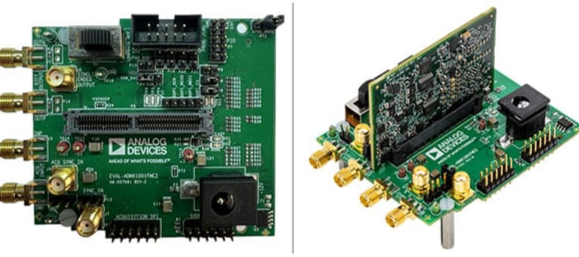
DPD is not only suitable for high-speed digital signals, but can also be used to improve the waveform of analog function generators. This function can be achieved by Analog Devices' ADMX1002B (Figure 1) ultra-low distortion, low noise, CNC arbitrary waveform generator (AWG). Please note that the ADMX1001B device, which is identical in other aspects, has added a differential analog input signal acquisition channel; We will provide a detailed introduction to this device later. The EVAL-ADMX100X-FMCZ evaluation kit supports these two devices.
Figure 1: ADMX1002B (left) is a high-precision sine wave and arbitrary waveform generator; ADMX1001B (right) is similar, but adds a data acquisition channel that is inserted into the connector on ADMX1002B in the form of a circuit board. (Image source: Analog Devices)
ADMX1002B utilizes the DPD algorithm to detect and correct its output through patented methods, providing the highest purity differential sine signal among similar products (Figure 2).
Figure 2: ADMX1002B integrates DPD algorithm, which can detect and correct its own output to achieve the highest accuracy; ADMX1001B has added data acquisition circuits as shown at the bottom and bottom right corner of the diagram. (Image source: Analog Devices)
When not using the DPD algorithm, the device provides an output of 30 Hz to 40 kHz; When calling DPD, the output can reach up to 20 kHz. The provided PC based graphical user interface (GUI) is connected to the system demonstration platform (SDP) controller board via a USB cable.
When a new sine wave frequency or amplitude is loaded into the register, non DPD is in default mode; This is the initial working mode for generating arbitrary waveforms. Due to its architecture, even in non DPD mode, the performance of the ADMX1002 module exceeds the native performance of the device.
Software or hardware can enable the DPD algorithm. This process does not require external reference inputs and utilizes patented differential time and amplitude detection methods.
This algorithm requires connecting the detection input to the output of ADMX1001 for use in processor routines to generate ultra-high purity sine waveforms. After enabling DPD, the typical value of total harmonic distortion (THD) at 1 kHz is extremely low, at -130 dB (decibels) (amplitude up to 3.62 V rms), and only decreases by a few dB until 20 kHz (Figure 3).