
- 4E, No.3 Shenfeng Road, Liuyao Community, Henggang Street, Longgang District, Shenzhen,China
- cc.shen@xypltd.com
- Call: +86 15112667855
News
Connectivity - The Pillar of Sustainable Automation
- 2026-11-24
Technologies such as SPE, PoDL, and Ethernet APL have overcome the traditional limitations of industrial communication. Advanced signal, data, and power interfaces are crucial here: they can help automation suppliers save resources and costs when connecting production equipment to the internet.
Picture of a man using a laptop in the computer room
(Image source: PeopleImages via Getty Images)
Digitization and seamless data networks enable enterprise processes to penetrate into production sites, which is a persistent trend in automation technology. Its goal is to create a highly flexible production environment that can be customized according to customer requirements to achieve unprecedented levels of diversity and productivity. Therefore, in the context of Industry 4.0, the manufacturing industry is undergoing a disruptive transformation, and the sustainable use of all available resources is one of the most important aspects.
Seamless connection from on-site to cloud
The seamless connection between machines, products, and ultimately humans is a characteristic of this transformation, which is beginning to penetrate the traditional boundaries between operational technology (OT) and information technology (IT) on a large scale. Nowadays, with industrial Ethernet technology, even field layer devices can achieve seamless broadband and low-cost interconnection with the company's cloud data infrastructure through TCP/IP. Unlike fieldbus, industrial Ethernet spans across all levels of automation - from field devices to the cloud, end-to-end. Therefore, factory and workshop operators can access equipment data in real-time and use it for production planning, process control, and data analysis.
For example, industrial Ethernet can collect and analyze data in real-time from sensors, power sources, or drivers. The conclusion of optimizing process parameters can be drawn through temperature changes or vibration information at critical points, as well as load curves. When an overload situation is expected, they will sound an alarm and prompt for early maintenance. In this regard, predictive maintenance is particularly important as it can help operators improve the availability of equipment and machinery, and minimize energy consumption and resource use - which reduces operating costs and greatly enhances the sustainability of process equipment and factory workshops.
Durable and sturdy RJ45 substitute
The physical backbone devices of these networks, especially industrial Ethernet, are high-performance interconnect technologies that can reliably transmit signals and data between various nodes in the automation network. In addition to the physical robustness required in industrial applications, these solutions now face many new challenges, such as the huge number of network nodes, miniaturization, or high transmission bandwidth challenges. Among them, it is particularly important to have a compact appearance, reduce installation and wiring workload, high signal integrity (i.e. precise electromagnetic interference shielding), and long-distance transmission reliability. The latter is particularly important when expanding the factory area. The power requirements for devices using data connectors are also increasing.
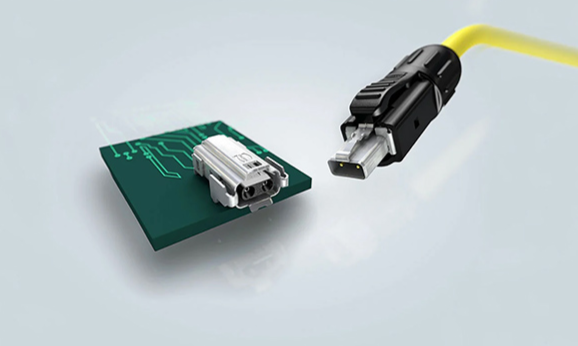
The standard interface for Ethernet communication is the widely used RJ45 connector. Users often report problems with damaged contacts or locking components; RJ45 also limits its miniaturization due to its size. In contrast, alternatives such as the ix Industrial interface from German supplier HARTING (Figure 1) are smaller in size, more robust and durable, especially with stronger impact and vibration resistance. According to the manufacturer, the space on the circuit board can be saved up to 70% compared to standard RJ45. The 360 ° shielded connector is designed specifically for 10 Gbit/s Ethernet communication and is compatible with PoE (Power over Ethernet) and PoE+for power transmission.
HARTING Industrial Ethernet Interface ix Industrial Image
Figure 1: Smaller and more robust than standard RJ45 connectors: HARTING's industrial Ethernet interface ix Industrial. (Image source: HARTING)
Ix Industrial is an interface jointly developed by HARTING and Japanese connector expert Hirose. Its size, electrical performance, and coding comply with the IEC 61076-3-124 standard. Other manufacturers, such as Amphenol Communications Solutions from the United States, also offer interoperable products that are comparable in performance to ix Industrial: for example, push-pull connectors with protection levels of IP65/66/67 for harsh environments, ix Mag connectors with integrated magnets (Figure 2), or Ethernet to RJ45 cable assemblies with angled RJ45 connectors; They provide both 100Gb Ethernet and PoE/PoE+functionality.
Amphenol ix Mag: Ethernet Communication
Figure 2: Amphenol ix Mag: Ethernet communication speed up to 10 Gb/s, 360 ° shielding, and PoE++up to 90 W (Image source: Amphenol Communications Solutions)
Ix Industrial Use Case
The following example illustrates the enormous potential of high-performance, miniaturized Ethernet interfaces in Industry 4.0 applications:
Beckhoff's XTS linear transmission system is a driving solution that uses a magnetic driven mobile device to move along a fully integrated motor module track. Beckhoff believes that these independent control devices that can achieve individual motion curves are the starting point of new machine concepts, enabling more flexible manufacturing processes (such as equipment replacement) and reducing downtime.
In order for the mobile device to follow its motion pattern, the computer must continuously calculate the switch and current supply of each motor module. For this purpose, a total of three computer boards can be combined together, with each board previously having four RJ45 sockets as ports. In order to enable more mobile devices to operate in the latest generation XTS system without changing the system size, RJ45 sockets have been replaced by HARTING's ix Industrial interface. Reliable shielding and high data throughput are the main requirements here. Unlike RJ45, each ix Industrial connector can connect two 100 Mbit/s Ethernet networks. Therefore, eight ports can be installed on the same circuit board instead of four, and each port can be equipped with two Ethernet channels instead of one.
Therefore, 48 ports were implemented on three computer boards instead of 12 ports. Therefore, with the adoption of the latest generation XTS system, each unit can use 48 XTS lines instead of 12, which is equivalent to a 400% improvement in the performance of the transportation system.
Two lines, not four or eight lines
A significant feature of today's industrial automation technology is the shift from hierarchical architecture to decentralized architecture. These devices are considered advanced, particularly effective, and can also enhance network security. This is because intelligent nodes such as intelligent sensors or edge computers can independently perform some data processing tasks, thus reducing the sensitive data traffic between the edge and the cloud. The advantages of decentralized management are self-evident, but the number of on-site connected devices is increasing significantly, and the workload of wiring and connection is also constantly increasing. From the perspective of materials, installation workload, and energy consumption, the economical use of these devices is becoming an important criterion for the sustainable development of production facilities.
Single pair Ethernet (SPE) is considered a decisive breakthrough in efficiency and cost-effectiveness. This communication technology is specified by the IEEE 802.3 standard; The IEC 63171-x series standards are applicable to the corresponding connectors. Fundamentally, it enables on-site components to be connected with just one twisted pair (i.e. two wires instead of the previous four or even eight wires): low cost, resource efficient, and therefore highly sustainable. SPE was originally developed for automotive electronics products and now meets the requirements of many automation suppliers: single wire pairs enable them to integrate a large number of instruments, controllers, and other devices into Ethernet networks at gigabit data rates (Figure 3).