
- 4E, No.3 Shenfeng Road, Liuyao Community, Henggang Street, Longgang District, Shenzhen,China
- cc.shen@xypltd.com
- Call: +86 15112667855
News
Complete Speaker Selection Guide
- 2026-09-29
Speaker is a transducer that converts electrical signals into audible sound waves for users, and is an important component in audio systems. To fully understand the role of speakers in sound reproduction, it is necessary to explore the engineering principles behind their operation and the key components involved. This article provides a detailed introduction to speaker technology, including basic working principles, important specifications, design considerations, cone and magnet types, etc.
Basic knowledge of speakers
The sound produced by a speaker is a carefully designed process that utilizes the principles of electromagnetism and mechanical motion. Everything starts with electrical signals, which represent the audio content that needs to be reproduced. This signal may come from various sources, such as smartphones, laptops, or any other audio device designed to generate electrical pulses. Whether it's the melody of a song, the clarity of a podcast, or the immersive effect of a movie, this signal is the electrical blueprint for the auditory experience that speakers are about to create.
The core components of a speaker are the voice coil and permanent magnet. A voice coil is usually a tightly wound wire connected to a flexible diaphragm or diaphragm. This coil is surrounded by a permanent magnet inside, establishing the core of sound generation. When an electrical signal passes through the wires of the speaker, the voice coil is energized and produces a series of actions driven by electromagnetic force. The current generates a magnetic field around the coil, and the polarity of the magnetic field changes with the variation of the electrical signal.
The motion of the speaker depends on the interaction between these magnetic fields. As the electric field fluctuates, they alternately repel and attract, causing the voice coil and its accompanying cone to move rapidly back and forth. The oscillatory motion of the music bowl interacts with the surrounding air molecules, causing them to vibrate along with the movement of the music bowl.
These vibrations generate pressure waves in the air, which propagate all the way to the human ear and are interpreted by the brain as sound. This completes the process of sound perception, converting electrical signals into rich auditory experiences.
Speaker working principle diagram
Figure 1: Working principle of loudspeaker. (Image source: Same Sky)
Through the study of speaker structure, we can discover several key components that work together to produce sound: soundstage, voice coil, soundboard, magnet, frame and yoke, and printed circuit board (PCB). The following illustration highlights the internal structure of the speaker in the disassembled (Figure 2) and assembled (Figure 3) states.
Exploded View of Speaker Components
Figure 2: Exploded view of the speaker assembly. (Image source: Same Sky)
Assembly drawing of speaker components
Figure 3: Assembly view of the speaker assembly. (Image source: Same Sky)
Important specifications and precautions for speakers
After gaining a basic understanding of the operation and structure of speakers, the important considerations when choosing a speaker are several key specifications and performance standards. These parameters are crucial for ensuring that the speaker can meet the required audio performance and reliability standards.
Sound pressure level (dB): Sound pressure level (SPL) quantifies the intensity of sound waves in the air, essentially representing loudness. The distance from the sound source and environmental conditions can both affect the sound pressure level. Decibel (dB) is a standard unit for measuring sound pressure level. Understanding sound pressure levels is extremely important for speaker design and noise level assessment in various environments, as it is crucial for noise control and regulation.
Maximum input power (W): This specification represents the maximum power that the speaker can withstand in a short period of time without permanent damage.
Nominal input power (W): The nominal input power refers to the safe power that the speaker can withstand during long-term continuous operation. This is the key to ensuring the long service life and high reliability of the speaker under normal operating conditions.
Impedance (Ω): Used to measure the resistance of current flowing from an amplifier to a speaker. The lower the impedance, the greater the power of the speaker, so the impedance of the speaker must match the impedance of the amplifier. Correct impedance matching is crucial for achieving optimal performance, efficient power transmission, maintaining high fidelity sound reproduction, and preventing equipment damage.
Resonant frequency (Hz): This is the most effective vibration frequency of the speaker, which helps to gain a deeper understanding of the low-frequency response of the speaker. Understanding the resonant frequency helps to compare the performance of different speakers, especially in low frequency performance.
Size (mm): The size of the speaker directly affects its frequency range. Smaller speakers are optimized for higher frequencies, while larger speakers perform better at lower frequencies. This relationship is crucial when designing systems for specific audio outputs such as deep bass or clear mid-range vocals.
Total Q value: The Thiele Small parameter (i.e. total Q value) is used as a broad benchmark for selecting the ideal enclosure type for speakers. If the total Q value is 0.4 or lower, it indicates that the speaker is most suitable for installation in a ventilated enclosure. A value between 0.4 and 0.7 suggests the use of a sealed enclosure, while 0.7 or higher indicates that the speaker is suitable for free air, semi open backplate, or infinite partition settings. However, these criteria are not absolute, it is important to consider all relevant parameters in the design to achieve ideal audio performance.
Intrusion protection: Speakers have various levels of intrusion protection (IP) to eliminate the effects of moisture and pollutants in harsh environments.
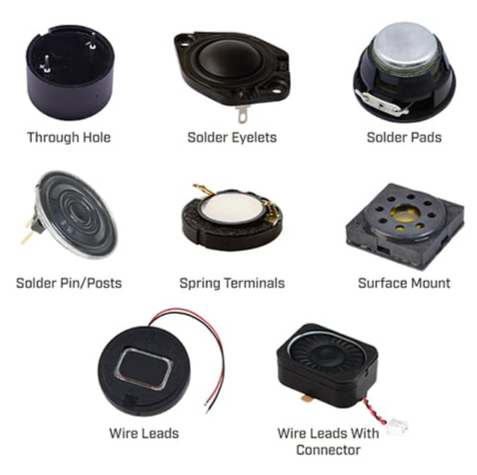
Installation method: Depending on the application needs, the speaker can be connected in different ways, including through holes, wire leads, spring terminals, etc.