
- 4E, No.3 Shenfeng Road, Liuyao Community, Henggang Street, Longgang District, Shenzhen,China
- cc.shen@xypltd.com
- Call: +86 15112667855
News
Choose thin film thermoelectric sensors for flame detection and gas analysis
- 2026-11-24
With the increasing attention to greenhouse gases in the environment and the need to measure air pollution and detect fires, gas identification and detection have become highly concerned areas for many people. This article will introduce how designers can use passive thermoelectric sensors suitable for gas and flame detection to address people's concerns.
Infrared (IR) sensing
Being able to sense gases in the environment is a very useful feature, especially for detecting environmentally sensitive gases such as carbon dioxide (CO2) and carbon monoxide (CO). The same technology can also be used for flame detection, as the main gases present in open flames are CO and CO2. Carbon monoxide, carbon dioxide, water vapor, methane (CH4) and other hydrocarbons (H-C), as well as several other gases, exhibit significant absorption spectra in the mid infrared range.
The spectral components of infrared radiation are between those of microwave and visible light, with a wavelength range of 0.76 μ m-1 mm. This range is further divided into three different sub regions: shortwave (or near-infrared), with a wavelength range of 0.76-3 μ m; Medium wave (or mid infrared), with a wavelength range of 3-14 μ m; Long wave (also known as far-infrared), with a wavelength range of 14 μ m-1 mm.
The absorption spectra of most relevant gases are in the mid infrared band (Figure 1).
Figure 1: Infrared absorption peaks of different gases in the mid infrared spectral range. (Image source: Broadcom)
Due to the fact that the main gases released by open flames are CO2 and CO, this technology can be used to detect flames.
infrared detection
Infrared radiation sources can be detected in various ways. Specifically, the near-infrared band can be detected using photodiodes. Other traditional detection methods include using a thermoelectric stack (a stack composed of thermocouples), which can respond to thermal radiation and generate a voltage proportional to the temperature change caused by infrared energy.
Recently, people have started using sensors that utilize thermoelectric effects to detect mid infrared to long infrared spectral bands. Thermoelectric effect refers to a phenomenon in which the surface of certain crystal materials can generate voltage when heated or cooled. We can understand this type of sensor as a capacitor that charges itself when exposed to infrared radiation. Compared to thermopiles, the advantages of thermoelectric sensors include faster response speed, better signal-to-noise ratio (SNR), and greater sensitivity due to their higher responsiveness. As for photodiodes, especially when measuring longer infrared wavelengths, they require cooling to achieve good signal-to-noise ratio. In contrast, thermoelectric sensors do not require cooling when measuring mid infrared to far-infrared spectral bands, making them more advantageous.
The production of infrared sensors can use thermoelectric materials such as lead titanate (PZT) or lithium tantalate (LiTaO3). When using these materials to make sensors, there are generally two ways: block form and thin film hybrid structure. Compared to devices made using thin film technology, block thermoelectric devices typically have poorer response speed and SNR.
Thin film thermoelectric sensors are generally equipped with a high gain amplifier to protect the thermoelectric device (Figure 2).
Figure 2: The packaging of the thin-film thermoelectric sensor includes a sensor chip, a high gain amplifier, and an integrated infrared filter. (Image source: Broadcom)
The amplifier adopts a low-noise CMOS operational amplifier (op amp) with a feedback resistance of up to 10 G Ω. The output signal is centered around half of the power supply voltage. This type of sensor has the characteristics of stable response, fast response, and wide operating frequency range.
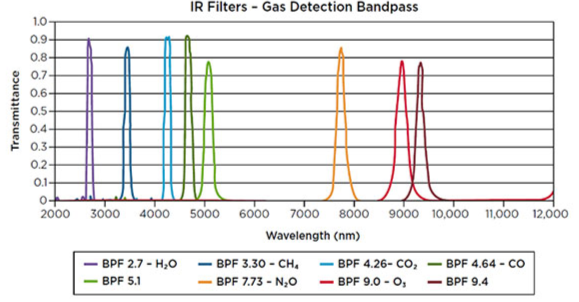
Filter is used to limit the wavelength range that the sensor responds to, and its main function is to adjust the sensor to a specific infrared wavelength.
Application of Thin Film Thermoelectric Sensors
Thin film thermoelectric sensors for detecting mid infrared bands are widely used, including flame detection, gas analysis, fuel and oil analysis, food safety, and environmental monitoring.
When used for flame detection, this infrared sensor can detect the infrared radiation from the flame. There are a large amount of hot gases around the flame, such as CO2 and CO. The flame and its surrounding gases are not stationary, but typically flicker at a frequency of 1-15 Hz. Infrared sensors monitor the spectral range of escaping gases with flicker frequency, thereby achieving precise detection of open flames.
The key characteristics of flame detection are field of view (FoV) and dynamic range (represented by signal-to-noise ratio), the larger the values of these two parameters, the better. Flame detection is triggered by the fire source itself, and in general, a single channel infrared sensor can be used.
Infrared gas analysis refers to an analysis based on the absorption of infrared light by the measured gas, which is called Non Dispersive Infrared (NDIR) spectroscopic analysis. Infrared emitters are the source of broadband infrared energy, including absorbed wavelengths. Gas analysis generally uses two infrared sensors, one of which is filtered to measure the absorption wavelength of the measured gas, and the other sensor is filtered through non absorption wavelength to provide a reference signal (Figure 3).
Figure 3: Schematic diagram of gas analysis device using thin film thermoelectric sensor. (Image source: Broadcom)
Inject an appropriate range of infrared wavelengths into a gas tube using a pulsed blackbody radiation source modulated at a frequency of 30-100 Hz. The gases inside the tube will absorb infrared energy according to their respective atomic structures. For example, CO2 absorbs energy with a wavelength of 4.26 μ m. Select the adjacent wavelength (3.9 μ m) that does not absorb CO2 as the reference wavelength. The reference channel can monitor any changes in the power of the infrared light source. To reduce interference, a blocking filter is used to limit the wavelength range received by the sensor to the range related to gas absorption and the wavelength of the reference channel.
The four most commonly monitored gases are oxygen (O), CO, CO2, and nitrogen oxide (NO). Compared with other methods, infrared sensors have obvious advantages, including long service life, fast response speed, no need for calibration, and the ability to detect and identify multiple gases.
Thin film thermoelectric sensor
With this information, you may be eager to develop your own thermoelectric sensor design solution. If you want to know where to get these devices, Broadco has stock for you to choose from, and these sensors use Broadco's own lead titanate thin film infrared technology. Broadco has analog single channel and dual channel infrared detection devices that are highly sensitive to discrete mid infrared bands, suitable for flame detection and gas analysis.
These sensors are packaged in TO-39 metal cans, making them ideal for outdoor use in industries such as heavy industry, oil and gas, infrastructure, and forest conservation. Outdoor use, as well as FoV and SNR, are important characteristics required by these industries (Figure 4).