
- 4E, No.3 Shenfeng Road, Liuyao Community, Henggang Street, Longgang District, Shenzhen,China
- cc.shen@xypltd.com
- Call: +86 15112667855
News
Building a more efficient and sustainable power grid using electrification and automation technology - Part 2 of 2
- 2026-11-24
Replacing traditional grid energy with sustainable green energy, also known as electrification. In the first part of this series, we discussed some challenges related to electrification and how automation can help improve efficiency and sustainability. This article is the second part, which will discuss the Leadership in Energy and Environmental Design (LEED) and Zero Energy Building (ZEB) certifications, and how they reduce carbon emissions and improve sustainability.
The Leadership in Energy and Environmental Design (LEED) and Zero Energy Building (ZEB) certifications represent significant efforts to support the entire society in reducing carbon emissions and improving sustainability. To obtain LEED and ZEB certifications, a holistic approach must be taken that combines electrification with advanced automation and control systems, replacing fossil fuel energy systems with green alternative methods such as photovoltaics (PV) and electric vehicles (EV).
The LEED program of the US Green Building Council (USGBC) includes decarbonization of existing and new buildings. The Office of Energy Efficiency and Renewable Energy (EERE) of the US Department of Energy is responsible for coordinating ZEB work. To obtain LEED and ZEB certifications, architects and contractors must adopt new methods for designing, constructing, and operating buildings. Compared to ZEB, which only focuses on energy consumption, LEED's concept is broader, involving carbon, energy, water, waste, transportation, materials, health, and indoor environmental quality.
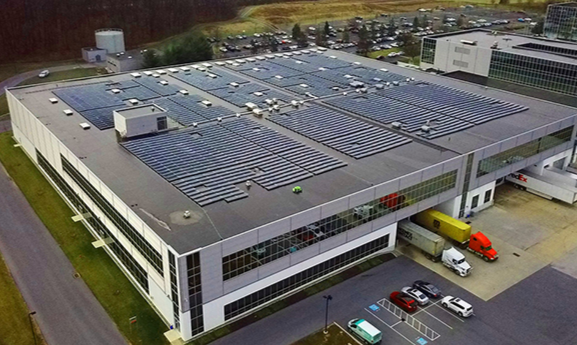
This article is the second in a series of two articles on electrification and sustainable development. It first introduces the LEED and ZEB certification levels, as well as the conditions that commercial and industrial buildings should meet to obtain these certifications. The article also includes a comparison of several definitions of ZEB. Then, provide a detailed introduction to how Phoenix Contact utilized automation and on-site photovoltaic power generation to achieve LEED Silver and ZEB certification for a 70000 square foot expansion project within its main campus, as well as how some of the company's own products played a role in the success of this project (Figure 1). Finally, introduce how LEED buildings contribute to achieving the United Nations Sustainable Development Goals.
Rooftop photovoltaic power generation
Figure 1: Roof mounted photovoltaic power generation is a key factor in the Phoenix Contact facility's LEED Silver and ZEB certifications. (Image source: Phoenix Contact)
LEED is holistic
LEED is a comprehensive system that takes into account all the conditions required to create high-performance buildings. LEED certification is determined based on the rating or score awarded to projects according to detailed performance standards. The various types of performance and their relative importance (ranked from most important to least important) are as follows: 1
Reduce the impact on global climate change.
Enhance the level of human health.
Protecting and restoring water resources.
Protect and strengthen biodiversity and ecosystem services.
Promote the circulation of sustainable and renewable materials.
Improve the quality of community life.
The most basic condition is to reduce the impact on global climate change, accounting for 35% of the total score. The certification levels of LEED include certification level (40-49 points), silver (50-59 points), gold (60-79 points), and platinum (above 80 points).
In the new LEED (4.1) standard, most of the ratings are related to operational carbon and embedded carbon. Operational carbon refers to the carbon dioxide (CO ₂) emissions generated by heating, ventilation, and air conditioning (HVAC), lighting, and other energy consuming building systems. Embedded carbon refers to the carbon emissions associated with the production of building materials and construction processes throughout the entire lifecycle of a building.
LEED certification is crucial for creating a greener society. The CO2 emissions from buildings account for 39% of global emissions, with 28% coming from building operations and 11% from embedded emissions from buildings (Figure 2). Due to the fact that buildings have the highest CO2 emissions globally, special plans have been developed to encourage the development of zero energy buildings.
CO2 producers worldwide
Figure 2: The operation, materials, and construction of buildings are the main factors contributing to global CO2 emissions. (Image source: New Buildings Institute)
Define zero energy consumption
Zero energy consumption may seem like a simple and straightforward concept, but it has multiple definitions. The three most cited projects among them are the LEED Zero Energy Project, the International Institute for Future Living (ILFI) Zero Energy Project, and the Zero Specification Renewable Energy Procurement Framework (Zero Carbon Specification) - Zero Carbon Specification is an initiative of the Building 2030 organization and has been adopted as the California Building Energy Standard. There are significant differences in how to define 'zero energy consumption'.
To obtain LEED zero energy certification, the building must have zero energy surplus within 12 months, including on-site power generation and externally generated (source) energy. Burning fossil fuels on site is not prohibited. The total energy consumption must include renewable energy or carbon offsets generated on-site or externally.
The ILFI zero energy certification standard is the strictest. This standard stipulates that on-site renewable energy can meet 100% of the building's energy needs. Burning is not allowed and certification is based on actual performance, modeling is prohibited.
The zero carbon standard specifically targets newly constructed commercial, institutional, and mid to high rise residential buildings. In this specification, zero carbon buildings refer to buildings that do not use on-site fossil fuels, produce or purchase sufficient carbon free renewable energy or carbon emission reduction rights to meet their own operational energy needs. The zero carbon standard also requires buildings to comply with ASHRAE Building Energy Efficiency Standard 90.1-2019. If other energy efficiency standards can bring equivalent or higher energy efficiency, it is allowed to replace the "zero carbon standard" with other energy efficiency standards.
LEED Model
Phoenix Contact recently installed a 961 kW photovoltaic system on the roof of its logistics center in the US main campus. The electricity generated by this system is sufficient to meet about 30% of the facility's energy needs, or equivalent to the annual energy consumption of approximately 160 households. The building has received the LEED Silver Award and zero energy certification.
The on-site 1 MW micro gas turbine cogeneration system is integrated with the photovoltaic system. The central energy control system monitors the output power of the photovoltaic power station and the energy consumption of the building in real time. When the overall energy demand exceeds the output of the photovoltaic system, micro turbine generators will be put into operation. Sometimes, photovoltaic systems and micro gas turbines operate simultaneously, supplying power to the grid through net metering and generating revenue for the company.
The design purpose of this system is to reduce natural gas consumption during the day and mainly operate micro turbine generators at night, thereby maximizing overall energy efficiency and reducing total CO2 emissions. At times, natural gas consumption can almost be reduced to zero. Some statistical data of photovoltaic systems include:
2185 solar panels
Annual power generation of 1214235 kWh
Reduce 1939279 pounds of CO2 footprint
In order to achieve the highest power generation efficiency and utilization, it is necessary to continuously monitor and control the individual photovoltaic system components in large-scale installations like this.