
- 4E, No.3 Shenfeng Road, Liuyao Community, Henggang Street, Longgang District, Shenzhen,China
- cc.shen@xypltd.com
- Call: +86 15112667855
News
Breaking through the limitations of simple solutions by using intelligent power supply device switches
- 2026-10-14
'Simple and easy to implement' is a well-known design principle and good engineering practice. After all, the more components added, the greater the likelihood of errors or unexpected occurrences. In addition, it will have a significant impact on the Bill of Materials (BOM).
However, each criterion has many reasonable exceptions. Especially when you want to design a sturdy, durable, and "knife and bullet proof" product that can work in both normal and extreme environments, withstand both foreseeable and inevitable pressures. To improve integrity, you may also want to reduce reliance on the system microcontroller unit (MCU) to handle disruptive events and instead rely on faster and more reliable built-in hardware, minimizing or not using software as much as possible.
Let's consider MOSFET based power switches, which have been widely used in automobiles and other applications, replacing traditional electromechanical relays. Dozens of such solid-state switches provide simple on/off control for the power rails of engines, transmissions, lighting, braking, wiring, and suspension control mechanisms. The service life of this type of semiconductor switch exceeds one million times, and unlike electromechanical relays, it is less likely to cause contact failure due to contact friction, aging, gas or carbide in harsh automotive environments.
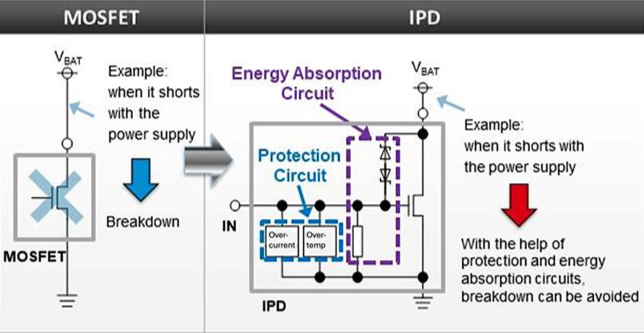
Conceptually, manufacturing a typical "on/off" switch is very simple. However, these MOSFET based switches may malfunction due to short circuits and transients when switching high-energy circuits during startup or normal operation. Therefore, various energy absorbing components with protective effects must be installed around the switch to make it a more precise device. These new components can be installed outside the MOSFET switch or inside its package, transforming it into a basic intelligent power device (IPD) switch (Figure 1).
Figure 1: A simple MOSFET can be used as a power switch (left image), but lacks energy absorbing components (right image) to protect it from the inevitable transient and short circuit effects in current practice. (Image source: ROHM Semiconductor, modified by the author)
More than that
In addition to using appropriate components around the power switch, there are more protective measures. Almost all current carrying rails require protection to prevent excessive current from damaging power switches or their load circuits. These overcurrent events are usually caused by internal faults in the load.
You may think that the solution for overcurrent protection is simple and well-known: simply install a basic hot melt fuse on the power rail. If overcurrent occurs, the fuse will melt, completely cutting off the flow of destructive current.
The fuse solution is effective, but in some aspects, it appears to be overcorrected. Once the fuse blows, the system MCU cannot understand the condition of the load module or manage it.
Therefore, many key circuits also adopt current monitoring function. In this way, the MCU can read the error signal detected by the overcurrent detection IC and send a signal to the IPD switch based on the subtle differences in the situation to initiate shutdown or repeat shutdown/restart operations.
However, this may lead to unstable circuit operation or other malfunctions. In contrast, ROHM Semiconductor's AECQ-100 series features advanced IPD switches that provide protection without the need for MCU intervention. These devices, which have obtained automotive certification (AEC-Q100), offer low or high voltage side switches in single channel and dual channel configurations. This series can adopt various 8-pin packages and support multiple voltage and current levels.
For example, BD1HD500FVM-CTR is a single channel high voltage side switch with a conducting resistance (RDS (ON)) of 500 m Ω, a current limiting value of 1.45 A, and an 8-lead MSOP package. In contrast, the single channel BV1LB025EFJ-CE2 is a low-voltage side switch with an RDS (ON) of 45 m Ω, a current limit of 13 A, and is packaged in HSSOP-C16.
The AECQ-100 series IPD switch can provide the minimum current level during the protection period, so if the circuit generates an error signal, it can still continue to operate. In this way, when non fatal abnormalities occur during the operation of the circuit, it is possible to issue an emergency "call".
In addition, these advanced IPD switches can also prevent power outages in the circuit. If the mechanical load increases due to aging, causing an increase in current consumption level, a power outage will occur. Due to the ability to operate independently without the need for MCU, not only is the number of components required for this function reduced, but reliability is also improved (Figure 2).