
- 4E, No.3 Shenfeng Road, Liuyao Community, Henggang Street, Longgang District, Shenzhen,China
- cc.shen@xypltd.com
- Call: +86 15112667855
News
Basic knowledge of thermoelectric generators
- 2026-06-11
In physics, we know that energy cannot be created or destroyed, it can only change its form. This is the law of conservation of energy, which prompts engineers to find ways to convert energy into more useful forms.
Thermal power generation is a good example, which can directly convert heat into electrical energy. This effect was first discovered by Thomas Seebeck and is now known as the Seebeck effect, which has been applied to devices called thermoelectric generators (TEGs). It was not until the 20th century that these solid-state devices made significant progress in practical applications, with the first commercial versions appearing in the 1960s. Since then, TEG has entered many different types of application fields.
Basic knowledge of TEG module
The working principle of thermoelectric generator module (usually referred to as TEG) is to convert temperature difference into voltage, and vice versa. This characteristic is called thermoelectric effect, which includes three related parts: 1) Seebeck effect, which generates electricity through temperature gradient; 2) The Peltier effect refers to the absorption or release of heat when current flows through two different materials; 3) The Thomson effect refers to the generation or absorption of heat based on the direction of current flow.
A common confusion point in thermoelectric technology is the difference between thermoelectric generators (TEGs) and thermoelectric coolers (TECs). TEG utilizes the Seebeck effect to generate electricity through heat, while TEC utilizes the Peltier effect to provide cooling or maintain a stable temperature. Both of these effects rely on similar semiconductor materials, but with different designs: TEG can achieve high temperature differentials and efficient power output, while TEC uses materials such as ceramics and copper to optimize heat conduction.
In fact, if the goal is to generate electricity using thermal energy, then the TEG module is the right choice. TEC or Peltier modules are more effective for cooling or temperature stability. Same Sky provides both TEG modules and Peltier modules, making it easier to select suitable devices according to design needs.
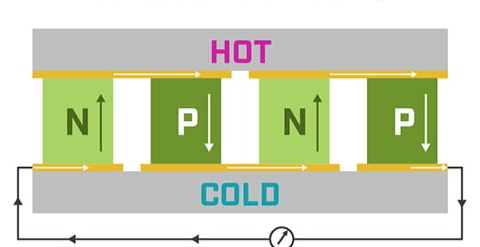
In modern thermoelectric generators (TEGs), electrical energy is generated when there is a temperature difference between the hot and cold surfaces. Inside the module, multiple pairs of n-type and p-type semiconductors (usually made of bismuth telluride) are placed between two plates (Figure 1). In n-type materials, electrons flow from the hot side to the cold side, while in p-type materials, the movement is caused by the migration of holes (i.e. electron vacancies) in the same direction. These two flows jointly generate voltage, and the larger the temperature difference, the higher the output voltage.
TEG is particularly valuable in situations where heat waste may occur, such as in industrial production, as it helps to recover lost energy. TEG can also operate in remote or extreme environments. For example, when there is insufficient sunlight, the heat generated by radioactive decay is converted into electrical energy to provide power for space probes.
Common structures of TEG modules
Figure 1: Common structure of TEG module. (Image source: Same Sky)
Advantages and disadvantages of TEG
The main advantage of thermoelectric semiconductor power generation (TEG) modules is their ability to convert waste heat into usable electrical energy, which helps to capture energy that would otherwise be lost. Therefore, TEG modules are not only practical but also environmentally friendly.
As TEG is a solid-state device, there are no moving parts, which means that this module has no audible noise, is sturdy and durable, and requires almost no maintenance. This module has a compact appearance, can be installed in small spaces, and provides multiple voltages and currents, without relying on traditional power grids to provide reliable power. This makes TEG an ideal choice for remote devices or alternative battery systems.
Although thermoelectric generators (TEGs) provide a reliable source of electricity, they also have design limitations. The performance of this generator largely depends on strong temperature differences, which limits their use in certain applications with thermal gradients. In addition, the conversion efficiency of TEG is usually low, typically around 10%, which is not high compared to many other energy generation technologies.
Main selection criteria for TEG
When integrating thermoelectric generator (TEG) modules into the system, key specifications that directly affect their performance must be considered. The most critical factor in the operation of a generator is the temperature difference between the hot and cold surfaces (usually referred to as Δ T). Although this will affect TEG's power generation, the data table does not always display it in this way. On the contrary, manufacturers usually list Tmax, which is the highest safe operating temperature, which helps to determine extreme conditions but may not necessarily be the optimal operating conditions.
Other useful specifications include open circuit voltage, matched load voltage, current, resistance, and power. Through these values, the performance of the thermoelectric generator under actual thermal and electrical loads can be understood. In data tables (such as Same Sky's data table), this information is usually displayed in the form of tables (Figure 2) and performance graphs (Figure 3) to make system level design easier.