
- 4E, No.3 Shenfeng Road, Liuyao Community, Henggang Street, Longgang District, Shenzhen,China
- cc.shen@xypltd.com
- Call: +86 15112667855
News
Artificial Intelligence Brings Supply Chain Improvement
- 2026-10-20
The global electronics supply chain is becoming increasingly unpredictable. The impact on the supply system has become more frequent and severe, and organizations are striving to mitigate this impact by increasing the resilience of their supply chains. And artificial intelligence (AI) technology can play an important role in it.
Seeking supply chain security
There are many threats that can cause supply chain disruptions (Figure 1). Although some threats can be foreseen, most of them are difficult to predict and could result in cost losses of millions to billions of dollars if they occur. These threats include human made challenges (such as regulatory changes), military conflicts, cyber attacks, or natural disasters such as epidemics and earthquakes.
Artificial Intelligence Promises Supply Chain Improvements
Figure 1: There are numerous, constantly changing, and inevitable factors that can cause supply chain disruptions. (Image source: McKinsey&Company)
What organizations must ask is not whether there will be an interruption, but what type of interruption is most likely to occur. It is also important to clarify how long potential disruptions will affect the supply chain.
These practical requirements have prompted the industry to invest in technologies that maximize supply chain transparency and resilience. When a supply chain crisis occurs, the organization that can quickly find alternative sources will win.
The Magic of Technology
The use of AI in supply chain applications and services can provide great assistance. There are countless use cases of AI in the supply chain, including: 1
Production Planning: AI can optimize production plans to improve delivery, adjust product priorities across product combinations, reduce production and distribution costs, and minimize the cost of last-minute changes.
Prediction and forecasting: AI can help us better understand procurement needs at any time by analyzing historical data, customer behavior, market trends, and various external factors.
Inventory planning and management: Traditional Material Requirements Planning (MRP) systems lack responsiveness. By modeling the uncertainty of supply and demand in the physical world, it is possible to reduce the need to maintain high inventory levels to cushion unexpected shocks.
Procurement: AI can build a unified supplier view to help organizations discover price changes, changes in supplier risk conditions, and opportunities for cost savings.
Supply network design: Through modeling, organizations can periodically re-examine their existing supply networks to improve flexibility, gain cost advantages, mitigate risks, and enhance customer responsiveness.
Logistics management: AI can help organizations identify emerging transportation and logistics issues in order to respond promptly and proactively.
AI has a good story to tell in actively identifying and responding to interference. 2 For example, AI can search the Internet for data of new potential suppliers. The information that AI can identify and mine includes supplier financial reports, customer ratings, sustainability scorecards, diversity scores, intellectual property information (such as patents and design awards), and US customs documents. For example, social media and news push can also provide some business information, such as changes in human resources and organizational restructuring.
AI also has great potential in helping manufacturers optimize their existing supplier management. For example, by delving into the supplier information held within the enterprise, some AI tools can determine supply choices for upcoming demand in the current business partner roster. These tools can utilize previous purchase orders, invoices, quotations, and other historical procurement data to identify potential procurement matches in the existing partner list. This can reduce the need to develop new suppliers, which is time-consuming, labor-intensive, and costly.
Measurable value
Company leaders are optimistic about the potential impact of AI. According to recent surveys, seven out of ten CEOs indicate that AI has brought significant investment returns to their organizations. The two areas with the highest deployment of AI are supply chain (data result of 76%) and procurement (data result of 71%). The second most common business activities are quality control (47%) and automation (37%).
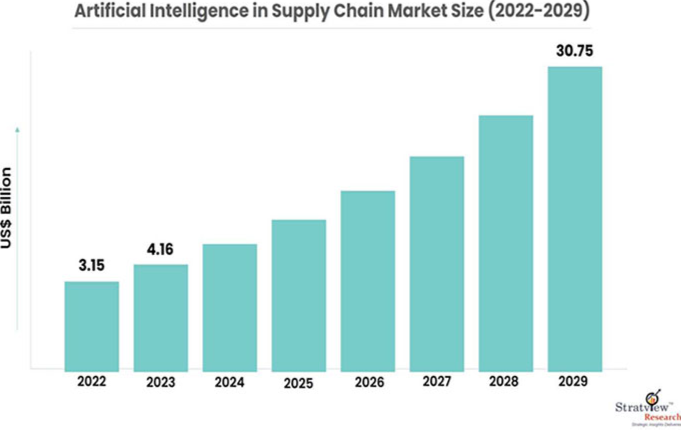
Market researchers have also made optimistic predictions about AI in the supply chain. According to Stratview Research's research (Figure 2), the market is expected to grow from $3.15 billion in 2022 to $30.75 billion in 2029. This is equivalent to an annual compound growth rate of 38.5%.