
- 4E, No.3 Shenfeng Road, Liuyao Community, Henggang Street, Longgang District, Shenzhen,China
- cc.shen@xypltd.com
- Call: +86 15112667855
News
Accelerate the development of long-distance connections using certified LoRaWAN modules
- 2026-11-24
In many sensor based large-scale production applications such as agriculture, asset tracking, utilities, and the Internet of Things (IoT), developers need to provide secure connections that can be used for a wider range of work. Designed specifically to support ultra large networks for such devices, the LoRaWAN protocol can provide an effective solution, but to quickly implement optimized communication subsystems, sufficient familiarity and professional knowledge are required.
This article briefly introduces LoRaWAN and its functions. Subsequently, Murata Electronics' LoRaWAN authentication module was introduced, which provides a ready to use solution for developers to achieve ultra long distance connections through low-power wide area networks (LPWAN). To accelerate the prototype design cycle, development boards and software support are also provided.
What is LoRaWAN?
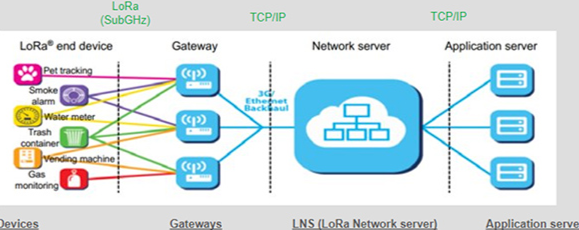
LoRaWAN has become an effective solution among existing wireless connectivity options, suitable for server based applications that can connect to low-power terminal devices far beyond the coverage range of commonly used wireless solutions such as Wi Fi or Bluetooth. In the LoRaWAN network, the application server communicates with the LoRaWAN gateway through the traditional Transmission Control Protocol/Internet Protocol (TCP/IP) network (Figure 1).
Typical LoRaWAN network application image (click to enlarge)
Figure 1: In a typical LoRaWAN network application, the server is connected to the gateway, which in turn utilizes the long-range, low-power capabilities of LoRa technology to connect terminal devices that may be located several kilometers away. (Image source: Murata Electronics)
The LoRaWAN gateway uses LoRa sub gigabit radio frequency (RF) technology used in unauthorized industrial, scientific, and medical (ISM) frequency bands to communicate with terminal devices. LoRa technology is aimed at relatively low bit rate applications, with a maximum bit rate of about 10 Kbps, but it has unique advantages in long-distance applications.
LoRa RF is based on spread spectrum technology, allowing developers to easily achieve reliable two-way communication over 15 kilometers in rural areas and over 5 kilometers in densely populated urban indoor locations by exchanging bit rates for distance.
With the security mode of LoRaWAN, the LoRaWAN protocol can protect communication traffic. LoRaWAN uses a pair of security keys: one to ensure packet level authenticity and integrity, and the other to provide end-to-end security for information between terminal devices and application servers.
The LoRaWAN protocol has more advantages in balancing the power consumption of terminal devices and the communication requirements of applications. There are three types of devices in LoRaWAN networks: Class A, Class B, and Class C. All three types of devices can transmit information as needed, but their category determines when they can receive information.
Class A devices have the highest energy efficiency and are designed for event driven operations, such as when sensors detect environmental changes. A-class devices can remain in a sleep state between two events, only waking up enough time to transmit data after the sensor collects data, and then opening the downlink receive window with a specified delay (RX1 and RX2) after uplink transmission (Figure 2).
Schematic diagram of uplink, first receiving window (RX1), and second receiving window (RX2) (click to enlarge)
Figure 2: The LoRaWAN class with the highest energy efficiency (Class A operation) allows the device to sleep for as long as possible, only starting to work when transmitting (uplink) data to the gateway, and opening the first receiving window (RX1) and the second receiving window (RX2) after the uplink is completed. (Image source: Murata Electronics)
B-class devices support regular operation according to the schedule required by the application. For Class B devices, the LoRaWAN protocol allows the device to open the downlink receive window according to a specified schedule, and use the beacon sent by the gateway to synchronize the terminal device with the network (Figure 3).
Schematic diagram of LoRaWAN Class B devices supporting synchronous downlink (click to enlarge)
Figure 3: LoRaWAN Class B devices use beacons sent by the connected gateway to maintain timing and achieve synchronized downlink. (Image source: Murata Electronics)
Class C devices are designed for applications that require terminal devices to continuously monitor downlink messages. Due to the need for C-class devices to remain active, they are typically powered by lines, while A-class and even B-class devices are powered by batteries (Figure 4).
Schematic diagram of LoRaWAN C-class devices remaining active at all times (click to enlarge)
Figure 4: LoRaWAN Class C devices are typically powered by a constant power source and remain active, constantly monitoring downlink messages when not transmitting uplink messages. (Image source: Murata Electronics)
Although the concept of LoRaWAN network may seem simple, its implementation requires sufficient knowledge and experience to find the right balance between the detailed operating parameters of LoRaWAN protocol and its underlying LoRa technology.
The certified LoRaWAN module provides a ready to use solution
Murata Electronics' LBAA0QB1SJ-296 module and associated firmware provide a ready to use solution that accelerates LoRaWAN network connectivity and offers a complete LoRaWAN authentication solution for terminal devices. This module integrates Semtech's SX1262 LoRa transceiver, STMicroelectronics' STM32L072 microcontroller (with 192 Kb flash memory), RF switch, and temperature compensated crystal oscillator (TCXO). It is encapsulated with shielding resin molding, with dimensions of only 10.0 x 8.0 x 1.6 mm (Figure 5).
Schematic diagram of Murata Electronics' LBAA0QB1SJ-296 module (click to enlarge)
Figure 5: Murata Electronics' LBAA0QB1SJ-296 module integrates Semtech SX1262 LoRa transceiver and STMicroelectronics STM32L072 microcontroller running preloaded LoRaWAN protocol stack, providing a complete LoRaWAN connectivity solution. (Image source: Murata Electronics)
This module uses a 3.3 V single power supply and consumes only 15.5 mA with a bandwidth of 125 kHz. Under the same bandwidth and maximum spreading factor, the packet error rate is 1%, and the receiver sensitivity is -135.5 dBm (decibel reference is 1 mW). In the implementation of LoRa's linear frequency modulation spread spectrum technology, the spreading factor is defined as the number of linear frequencies per bit. In terms of transmission, the module can provide up to+21.5 dBm of transmission power, with a maximum power consumption of 118 mA.
The LBAA0QB1SJ-296 module supports LoRaWAN Class A, B, or C devices and provides multiple low-power operating modes, allowing developers to balance performance and power consumption. For battery powered terminal devices (usually operating in Class A or Class B), this module can operate in ultra-low power mode, with a real-time clock running at a power consumption of only about 1.3 µ A, and can therefore run for several years.